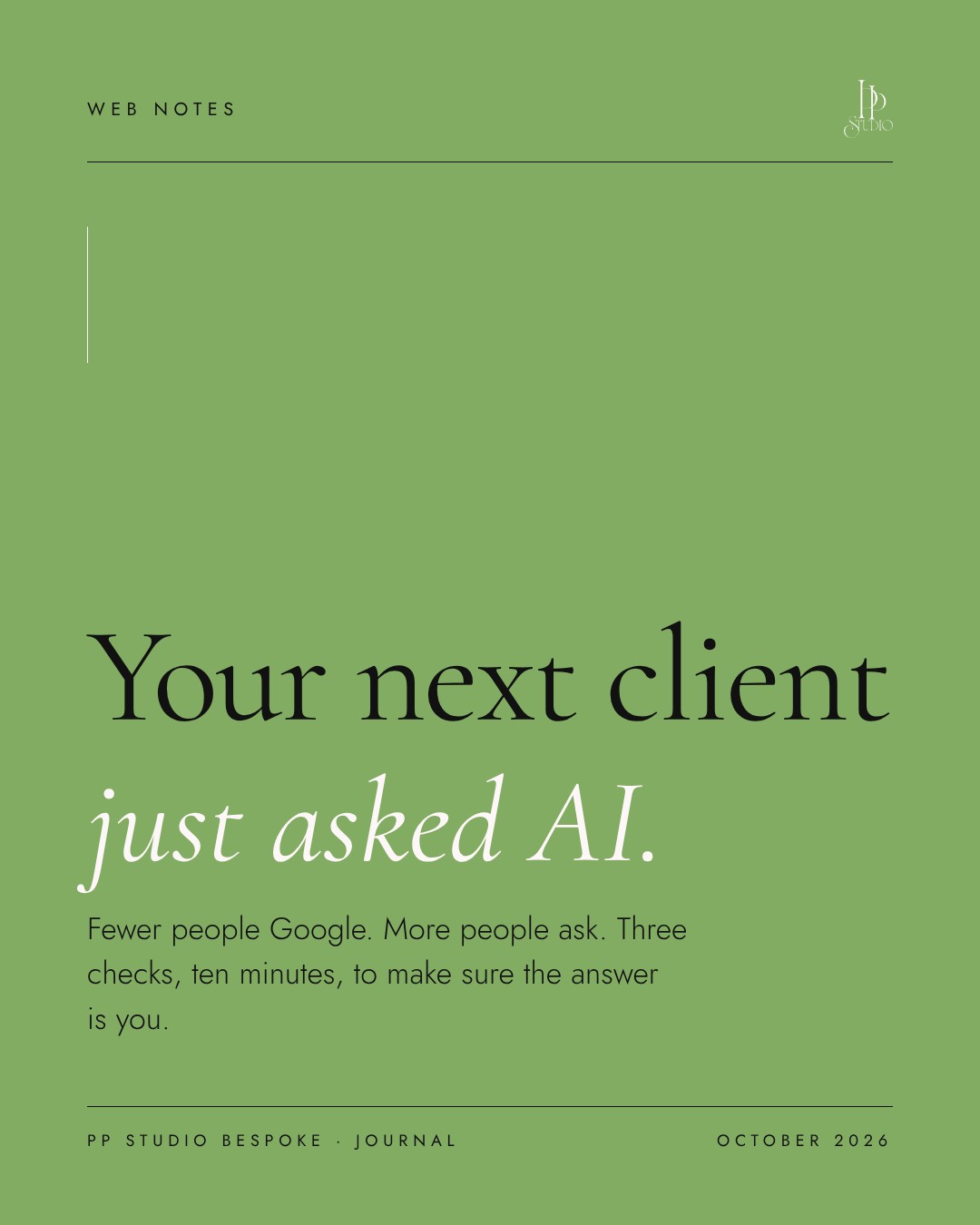
Search has changed quietly, and faster than most brands have noticed. ChatGPT, Claude and Perplexity now recommend businesses by name, and very often they recommend only one or two. If a client asks for "the best wedding stationer in Zürich" and your studio is not in the answer, you were never on the shortlist.
The good news: making sure AI can find and understand you takes about ten minutes to check. Here are the three checks I run for every client website.
i. Ask it yourself
Open ChatGPT, Claude or Perplexity and ask exactly what a client would ask: "Who is the best [what you do] in [your city]?" Then ask about your studio by name. Does it know you exist? Does it describe you correctly? This is your new first page of Google.
ii. Open the door
Visit yoursite.com/robots.txt. Some website settings quietly block AI from reading you at all. If you see a line such as User-agent: GPTBot followed by Disallow: /, it means "do not read me". Ask your web designer to allow GPTBot, ClaudeBot and PerplexityBot. Every website the studio builds welcomes them by default.
iii. Say it in words
AI reads text, not mood. A beautiful website that never says plainly who it serves, where, and what it does is invisible to it. Not "Crafting beautiful moments." But "Bespoke wedding stationery in Zürich." You can keep the poetry; simply give it a clear sentence to stand on.
Elegance and clarity are not opposites
The most refined websites I know manage both: an editorial look for the people who visit, and clear, well-structured words for the machines that recommend them. That balance is now part of every website the studio designs.
Would you like me to check yours? Send me a note and I shall reply personally.